

INM-901 for Alzheimer's disease
InMed’s INM-901 is a novel, small molecule drug candidate in development for the treatment of Alzheimer’s Disease.
INM-901 significantly reduces neuroinflammation in preclinical studies
InMed’s INM-901 is a small-molecule, orally-available drug candidate being developed for Alzheimer’s disease. Promising studies demonstrate INM-901’s ability to reduce neuroinflammatory markers associated with Alzheimer’s disease.
In a recent Alzheimer’s disease ex vivo preclinical study, INM-901 significantly reduced neuroinflammation, a recognized contributor to Alzheimer’s disease development and progression.
Key Findings from the Study:
- INM-901 significantly reduced levels of NLRP3 and IL-1β, two inflammasome markers increasingly implicated in the pathogenesis of Alzheimer’s disease and other neuroinflammatory diseases.
- INM-901 treatment resulted in a dose-dependent and statistically significant reduction in several key pro-inflammatory markers, including IL-6, IL-1β, KC/Gro, and IL-2.
- INM-901 reduced key pro-inflammatory markers, independent of amyloid-beta or tau pathology, signifying potential to treat other dementia-related diseases.
INM-901 demonstrates promising disease-modifying effects in Alzheimer's disease studies
InMed has conducted several in vitro and in vivo studies to test the pharmacological effects of INM-901 in Alzheimer’s disease preclinical models with promising results demonstrating disease-modifying effects.
A summary of INM-901 preclinical study results:
- demonstrates neuroprotective effects by reducing cell death in an amyloid-beta-induced cytotoxicity study
- demonstrates significant reduction in inflammatory biomarkers associated with Alzheimer’s, including IFN-γ, TNF-α, IL-1β, KC-GRO, IL-2 & NfL
- may have a direct impact on neuroinflammation independent of the influence of amyloid beta or tau aggregation
- demonstrates an ability to promote neurite outgrowth, signifying the potential to improve neuronal function, a potential breakthrough in the treatment of Alzheimer’s disease
- demonstrates a trend in improvement in cognitive function and memory, locomotor activity, anxiety-based behavior, sound awareness and neuronal function
- demonstrates robust bioavailability in in vivo models, achieving what is anticipated to be therapeutic levels of systemic exposure
- Additional mRNA data supports the observations made in behavior studies in locomotor activity, cognition and memory.
InMed conducted longer-term in vivo studies with INM-901 demonstrating favorable behavioral outcomes, confirming previous short-term pilot study data.


INM-901 targets CB1 and CB2 receptors
INM-901 potentially offers a unique treatment approach that may target several biological pathways associated with Alzheimer’s disease.
In a well-characterized in vivo Alzheimer’s disease study models, it was observed that INM-901 is a preferential signaling agonist of cannabinoid receptor 1 (CB1) and cannabinoid receptor 2 (CB2).
Activation of CB1 and CB2 receptors has been shown to have neuroprotective effects, meaning they can help protect brain cells from damage and death. In Alzheimer’s disease, where neuronal cell death is a hallmark feature, enhancing the activity of these receptors may help to slow down the progression of the disease. Activation of these receptors has also been shown to have an impact on neuroinflammation. As neuroinflammation is also believed to contribute to the progression of Alzheimer’s disease, targeting these receptors could help alleviate this inflammatory response. While further research is needed to fully understand the role of CB1 and CB2 receptors in Alzheimer’s disease, targeting these receptors could offer novel therapeutic strategies for the treatment of this devastating condition. (1)(2)
INM-901 - Targeting Initiation of Phase 1 Clinical Trial in Alzheimer’s Disease in 2027
InMed is accelerating development of its Alzheimer’s disease program.
2026 Development Priorities for INM-901 include:
- Conduct a pre-IND meeting with the U.S. Food and Drug Administration in Q3/2026.
- Continue to execute on IND-enabling pharmacology and toxicology studies.
- Continued development and scale up of drug substance and product manufacturing activities to support IND enabling studies and submission.
- Engage regulatory / clinical experts to map out topline clinical design for first in human clinical trials for the INM-901.
- Subject to regulatory feedback and completion of IND-enabling activities, the Company targets submission of an IND and initiation of a Phase 1 clinical trial in 2027.

INM-901 can be utilized as an oral formulation
InMed conducted preclinical studies confirming that INM-901 can be administered orally and achieve therapeutic levels in the brain comparable to those obtained through intraperitoneal (“IP”) injection, which is a common route of administration for preclinical investigation of neurodegenerative diseases. The data indicates the INM-901 formulation can be administered orally and maintains a similar drug exposure levels as IP delivery over a 24-hour period in the brain. This oral delivery method offers potential advantages such as reduction in treatment delivery costs.
One of the main challenges of the newly-approved disease-modifying monoclonal anti-bodies is their drug delivery limitations. As large molecules, the monoclonal antibodies are administered via intravenous infusions every two to four weeks typically at a medical site by trained staff.
The drug delivery options of small molecules could greatly reduce treatment costs and the compliance challenges associated with large molecule antibody therapies.

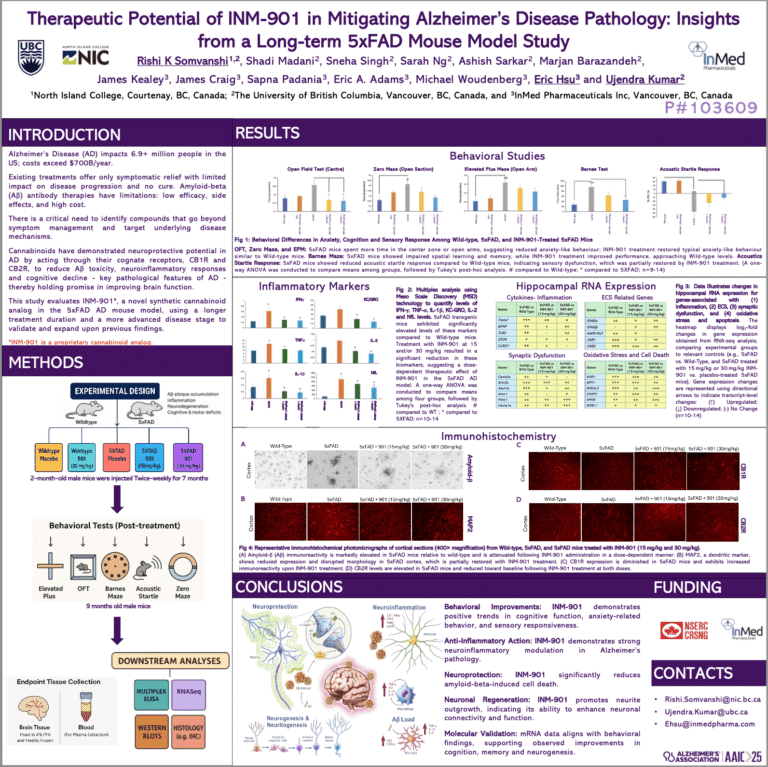
InMed presents INM-901 data at 2025 Alzheimer's Association International Conference
Data was presented in a scientific poster entitled, “Therapeutic Potential of INM-901 in Mitigating Alzheimer’s Disease Pathology: Insights from a Long-term 5xFAD Mouse Model Study“.
This latest study evaluates INM-901 in the well-established 5xFAD AD mouse model, using a longer treatment duration and subjects with more advanced disease to validate and expand upon previous findings, which have demonstrated improvements in cognitive function, anxiety-related behavior, and sensory responsiveness.
Summary of INM-901 Long-term 5xFAD study:
- Hippocampal RNA Expression – Several genes associated with inflammation, the endocannabinoid system, synaptic dysfunction and oxidative stress and apoptosis (cell death) were evaluated following treatment. In some cases, INM-901 demonstrated a dose-dependent trend towards a return to non-diseased baseline following treatment.
- Inflammation – Treatment with INM-901 resulted in a significant reduction in the inflammatory biomarkers IFN-γ, TNF-α, IL-1β, KC-GRO, IL-2 and NfL, suggesting a dose-dependent therapeutic effect in neuroinflammation.
- Immunohistochemistry – Amyloid-beta (Aβ) immunoreactivity is reduced following INM-901 treatment in a dose-dependent manner. MAP2, the microtubule-associated protein 2 is a protein found in the neurons, especially in the dendrites and is involved in neurite outgrowth and signal transduction of the neurons, is partially restored with INM-901 treatment.
- Behavioral – Cognitive function, anxiety-related behavior, and sensory responsiveness were restored or approaching normal following INM-901 treatment.

Alzheimer’s disease – a major unmet medical need
Newly-approved Alzheimer’s disease medications primarily address symptoms related to memory and cognitive function via the reduction of beta-amyloid plaques. Some may slow the rate of cognitive decline, but no treatment has shown to reverse its effects. These medications are aimed at removing amyloid plaque build-up between the neurons in the brain; however, they do not restore or rebuild deteriorating neurons and thus do not reverse Alzheimer’s disease progression. In addition, these treatments are related to some significant side effects, including inflammation and bleeding in the brain, requiring brain scans once or twice a year. The administration of these treatments, which include an intravenous infusion every 2-4 weeks, also presents a challenge.